Shutdown and Turnaround Rescue Management: The High-Stakes World of Planned Industrial Maintenance
By LifeGear Expert
2026-06-10
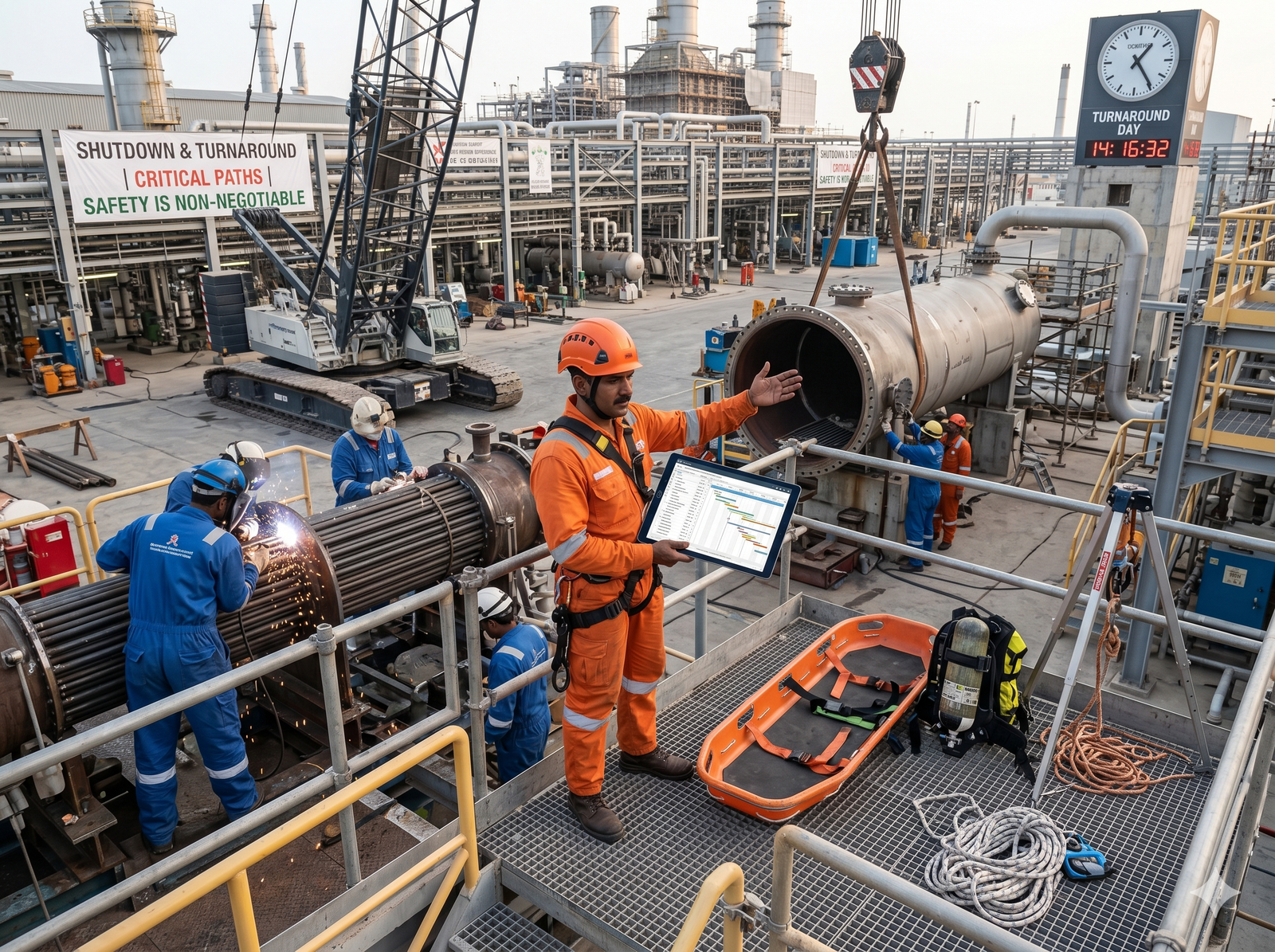
Among all the operational scenarios encountered in India's heavy industry sector, the scheduled plant shutdown and turnaround maintenance period represents the single highest concentration of life-safety risk. In a normal operating period, high-risk tasks are distributed across time and space — a confined space entry here, a height-access job there — each managed within a routine permit-to-work framework. During a shutdown, the same high-risk tasks are compressed into a period of days or weeks, executed simultaneously across multiple locations, by a workforce that has expanded by a factor of two, three, or even five with contractor personnel who may be unfamiliar with the specific hazards of the site. The result is a risk profile that is qualitatively and quantitatively different from normal operations — and that demands a rescue management approach that is similarly elevated.
Despite this reality, the majority of Indian industrial plants manage shutdown rescue readiness through the same general safety structure they use for normal operations. The site fire brigade remains the nominal emergency response capability. Safety officers who are responsible for permit-to-work during normal operations assume responsibility for standby coverage of high-risk shutdown activities. The result is an emergency response capability that is simultaneously overextended in terms of demand and underprepared in terms of competency. When a confined space incident or a fall-from-height injury occurs during a shutdown — and statistics show that the probability of such incidents is significantly elevated during this period — the response available is frequently inadequate.
What Makes Shutdown Rescue Technically Distinct
The technical distinction of shutdown rescue management lies in three factors: simultaneity, temporary infrastructure, and contractor workforce density. Simultaneity means that during a shutdown, multiple high-risk tasks — vessel entries, elevated structural work, hot work in confined areas — are occurring at the same time across the plant. A single rescue standby team cannot be physically present at more than one location simultaneously. Shutdown rescue management therefore requires a matrix approach: multiple dedicated standby rescue teams, each assigned to specific work zones or specific high-risk permits, operating under a centralised rescue coordination structure.
Temporary infrastructure — scaffolding, temporary access platforms, portable lifting equipment — introduces rescue scenarios that are not present in normal operations. A rescuer responding to a fall-from-height incident on temporary scaffolding needs to assess a structural configuration that may differ significantly from the permanent plant infrastructure they are trained against. Pre-shutdown Rescue Site Assessments (RSA) for all temporary structures and all confined space entries in the shutdown scope are therefore not optional — they are the foundational planning document for every rescue team deployed during the shutdown period.
The Lifegear Shutdown Rescue Division
Lifegear operates a dedicated Shutdown and Turnaround Rescue Division that is separate from its permanent contract operations. This division is staffed by senior rescue professionals — Rescue Leaders and Rescue Supervisors with ITRA Level 2 and Level 3 certification and a minimum of five years of active rescue deployment experience — who specialise in the planning, mobilisation, and operational management of shutdown rescue coverage. Unlike general safety personnel who are redeployed from normal duties to cover shutdown activities, Lifegear's shutdown rescue teams are constituted specifically for the shutdown, briefed comprehensively on the shutdown scope, and assigned to rescue coverage zones based on the risk profile of the work plan.
The Lifegear shutdown rescue deployment process begins 4–6 weeks before shutdown commencement with a pre-shutdown site assessment conducted by a senior Rescue Leader. This assessment identifies all confined space entries, all significant height-work activities, all SIMOP (simultaneous operations) scenarios, and all locations where standby rescue coverage is required. From this assessment, a Shutdown Rescue Plan is produced — a document that specifies the number of rescue teams required, their zone assignments, their shift patterns, their equipment complement, and their escalation protocols. This plan is integrated into the client's overall shutdown Management of Change (MOC) process and is available in real time via the RAP digital platform throughout the shutdown period.
Managing the Entire Rescue Operation: Daily Operations and Controls
During the shutdown itself, Lifegear's rescue team management is continuous and systematic. At the start of each shift, the Rescue Leader conducts a team briefing covering the day's rescue priorities, new high-risk permits issued, any changes to the rescue zone assignments, and equipment readiness status. RAP is used to log every rescue observation, every equipment inspection, and every rescue plan update in real time — creating a live, auditable record of rescue readiness throughout the shutdown period. Plant HSE managers and heads can access this data through the RAP dashboard from any device, giving them real-time visibility of rescue readiness across all shutdown work zones.
Post-shutdown, Lifegear produces a comprehensive Rescue Operations Report covering incident observations, near-miss recordings, equipment utilisation, team performance metrics, and lessons learned. This report serves as both a compliance document for post-shutdown audits and a continuous improvement input for the next shutdown cycle. For plants that operate on annual or bi-annual shutdown cycles, this longitudinal data — accumulated across multiple shutdown periods — provides a unique operational intelligence baseline that enables each successive shutdown to be managed with progressively higher rescue readiness and lower incident risk. Lifegear's shutdown rescue service is not a mobilisation of bodies. It is the deployment of a mature, systemised rescue management capability built on 20 years of operational experience in India's most demanding industrial environments.
References & Further Reading
- Lifegear Safetech: https://www.lifegear.in
- ITRA: https://www.technicalrescue.org/
Ready to Take Action?
- Contact Lifegear for a Live Demo of RAP (Rescue Application Platform) — www.lifegear.in
- Inquire About Rescue Contracts — Permanent, Shutdown & Turnaround Rescue Coverage Across India
- Learn More About ITRA Certification — www.technicalrescue.org