The Portable Safety Machine: Why Wheeled AI Units Beat Fixed CCTV
By Lifegear Team
2026-09-15
Introduction: Why Fixed CCTV Can't Always Follow Industrial Risk
Fixed CCTV has one fundamental limitation: it watches the location where it was installed.
Industrial risk, however, does not always stay in one location.
A plant shutdown can create a temporary confined-space operation in an area that has never required dedicated camera coverage. A construction project can move its active work zone every few days. Maintenance activities can suddenly create high-risk operations outside the normal surveillance footprint.
Installing permanent CCTV everywhere is rarely practical.
It requires mounting infrastructure, cabling, power, network connectivity, IT coordination, and facilities support. By the time a new camera is installed and configured, the temporary high-risk activity may already be over.
Lifegear's wheeled RASU approaches the problem differently.
Instead of bringing the job to the camera, the camera and AI safety system can be moved to the job.
1. The Problem With Surveillance That Can't Move
Traditional CCTV infrastructure is designed around fixed locations.
Once a camera is mounted, its field of view is largely determined by where that camera has been installed. If the work moves outside that field of view, the surveillance coverage does not automatically move with it.
This creates a practical challenge for industrial safety teams.
A facility may have extensive CCTV coverage and still have blind spots exactly where temporary high-risk work is taking place.
For example, a maintenance team may begin work in a remote section of a plant, a contractor may establish a temporary work zone, or a construction project may shift operations to a completely different part of the site.
Installing permanent surveillance for every possible future work location would be expensive and inefficient.
The alternative is a safety system that can be deployed wherever the risk appears.
2. What the Wheeled RASU Actually Delivers
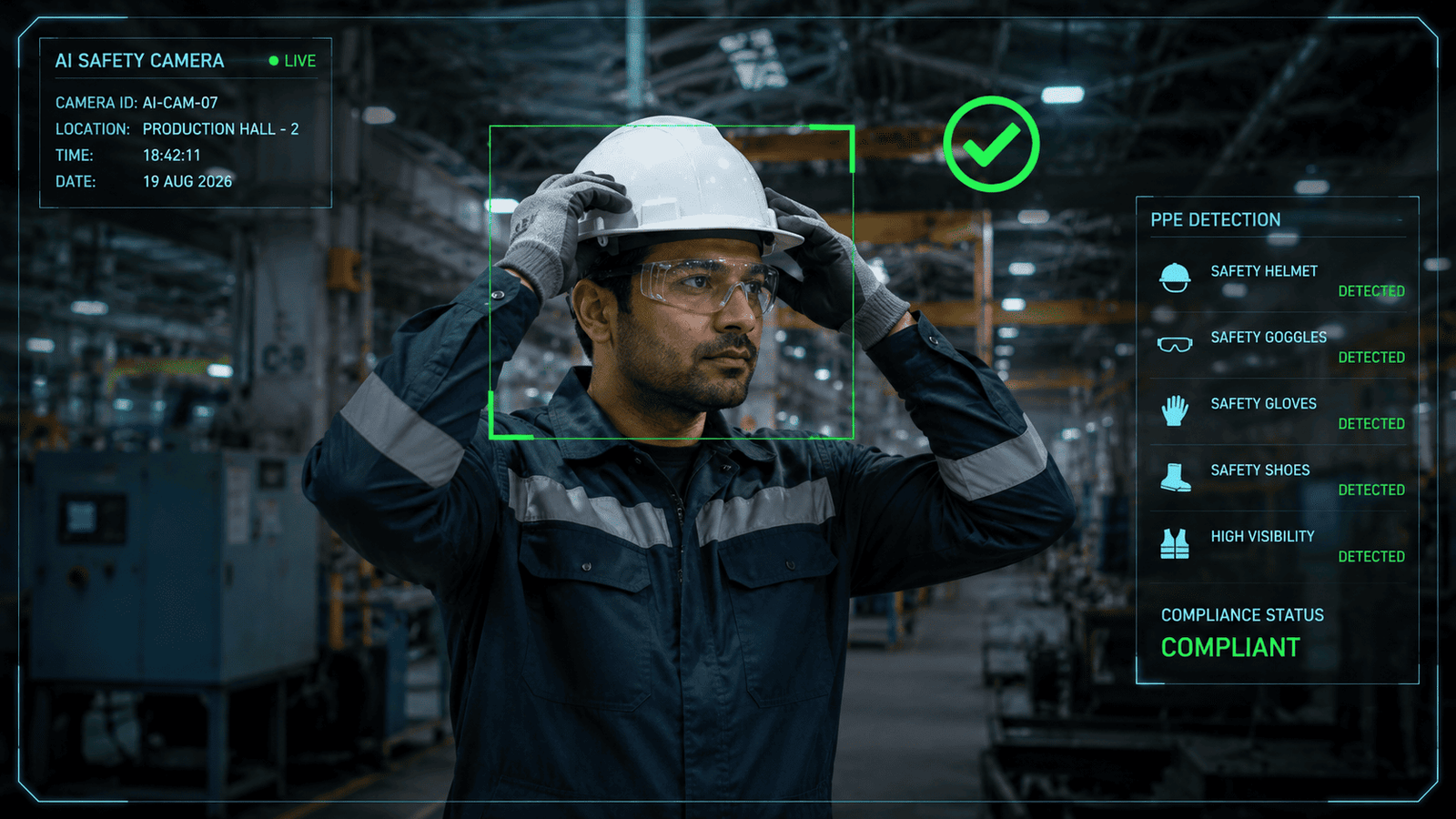
RASU's wheeled, standalone form factor is designed to make AI-powered safety monitoring portable.
Instead of requiring a new fixed installation for every temporary work area, the unit can be repositioned to the required zone.
That means no permanent camera mounting is required for every location, and deployment does not have to wait for a lengthy infrastructure installation process.
The mobility of the platform allows safety teams to bring AI-powered video analytics directly to the work area.
The basic deployment model becomes:
Identify Risk → Move RASU → Position Unit → Activate Monitoring → Monitor Work
This makes the system particularly useful for facilities where work locations change frequently or where temporary safety monitoring is required.
3. Why Mobility Matters During Temporary High-Risk Work
Some of the most important safety operations are temporary.
Confined-space work, maintenance shutdowns, construction activities, equipment servicing, inspections, and contractor operations may only take place for a few hours or days.
Building permanent CCTV infrastructure for each temporary operation may not make economic or operational sense.
A portable AI safety unit provides another option.
RASU can be positioned close to the temporary work zone and used while the operation is underway. Once the work is completed, the unit can be moved to the next location where monitoring is required.
This turns safety monitoring into a deployable resource rather than a permanent infrastructure project.
For HSE teams, that means surveillance capacity can be allocated according to current risk instead of historical camera placement.
4. Deploying AI Monitoring Without Waiting for Infrastructure
Fixed CCTV installations often involve several dependencies.
A new camera may require:
- Physical mounting
- Power availability
- Network cabling
- IT configuration
- Facilities approval
- Camera positioning
- System integration
- Testing and commissioning
For a permanent surveillance requirement, those steps may be justified.
For a temporary high-risk operation, they can create unnecessary delays.
RASU's portable design reduces the infrastructure required to place AI-powered monitoring where it is needed.
This can be particularly valuable for contractors and project teams working across multiple sites.
Instead of designing a new surveillance infrastructure for every location, a standardized safety monitoring unit can be deployed as part of the operational safety setup.
The result is a more flexible approach to industrial surveillance — one that can adapt to the project rather than forcing the project to adapt to existing camera locations.
5. Following Risk Instead of Waiting for It
Industrial risk is dynamic.
The highest-risk area at 8:00 AM may not be the highest-risk area at 2:00 PM. A shutdown can completely change the safety profile of a facility. Construction work can move from one section of a site to another as the project progresses.
Fixed cameras provide continuous coverage of their designated areas, but they cannot automatically relocate when the risk moves.
A mobile AI platform changes that equation.
RASU allows safety teams to move monitoring capability to the areas where it is most relevant.
Instead of asking:
"Where do we already have a camera?"
the safety team can ask:
"Where is the risk today?"
That is the fundamental advantage of portable safety monitoring.
6. Where Portable AI Safety Monitoring Makes the Most Sense
Wheeled AI safety units are particularly useful in environments where work zones change frequently or where permanent camera coverage is difficult to justify.
Typical applications include:
- Construction sites
- Plant shutdowns and turnarounds
- Temporary maintenance zones
- Confined-space operations
- Large warehouses
- Industrial plants
- Infrastructure projects
- Contractor work areas
- Remote sections of large facilities
- Temporary high-risk work zones
In these environments, mobility allows one AI-enabled safety platform to serve multiple locations over the course of a project.
Instead of installing dedicated systems everywhere, the monitoring capability can be repositioned according to operational requirements.
Conclusion
Fixed CCTV remains valuable for permanent surveillance, but it has an inherent limitation: it can only monitor the locations it has been installed to cover.
Industrial work does not always respect those boundaries.
Construction zones move. Shutdown activities create temporary hazards. Maintenance teams work in areas that may not normally require surveillance. Contractors move from one project area to another.
A wheeled AI safety platform such as Lifegear's RASU provides a different model.
It brings AI-powered monitoring directly to the work zone, allowing safety teams to deploy surveillance where the current risk actually exists rather than waiting for permanent infrastructure to be installed.
For facilities and contractors that need flexible, rapid-deployment safety monitoring, mobility turns AI surveillance from fixed infrastructure into an operational safety resource that can follow the work wherever it goes.
Ready to Take Action?
- Deploy Safety Monitoring Anywhere in Minutes — Learn More About RASU
- Talk to Our Safety Engineers — Discuss your site conditions, temporary work zones, and mobile monitoring requirements
- See RASU in Action — Explore how portable AI-powered safety monitoring can support changing industrial environments
References & Further Reading
- Lifegear Safetech — RASU AI Safety Systems: www.lifegear.in
- Lifegear — AI-Powered Industrial Safety Solutions: www.lifegear.in