Voice That Saves Lives: The Case for Multilingual On-Site Safety Alerts
By Lifegear Team
2026-09-06
Introduction: Why Safety Alerts Need to Be Understood, Not Just Heard
A safety warning is only effective if the person receiving it understands what it means and knows what action to take.
India's industrial workforce is linguistically diverse. A single plant floor can include workers whose first languages range from Hindi and Marathi to Odia, Telugu, Bengali, Kannada, Tamil, or other regional languages.
In these environments, communicating safety instructions in only one language can create an avoidable barrier.
A siren may tell everyone that something is wrong, but it does not necessarily tell a worker what has happened, what they need to correct, or what action they should take.
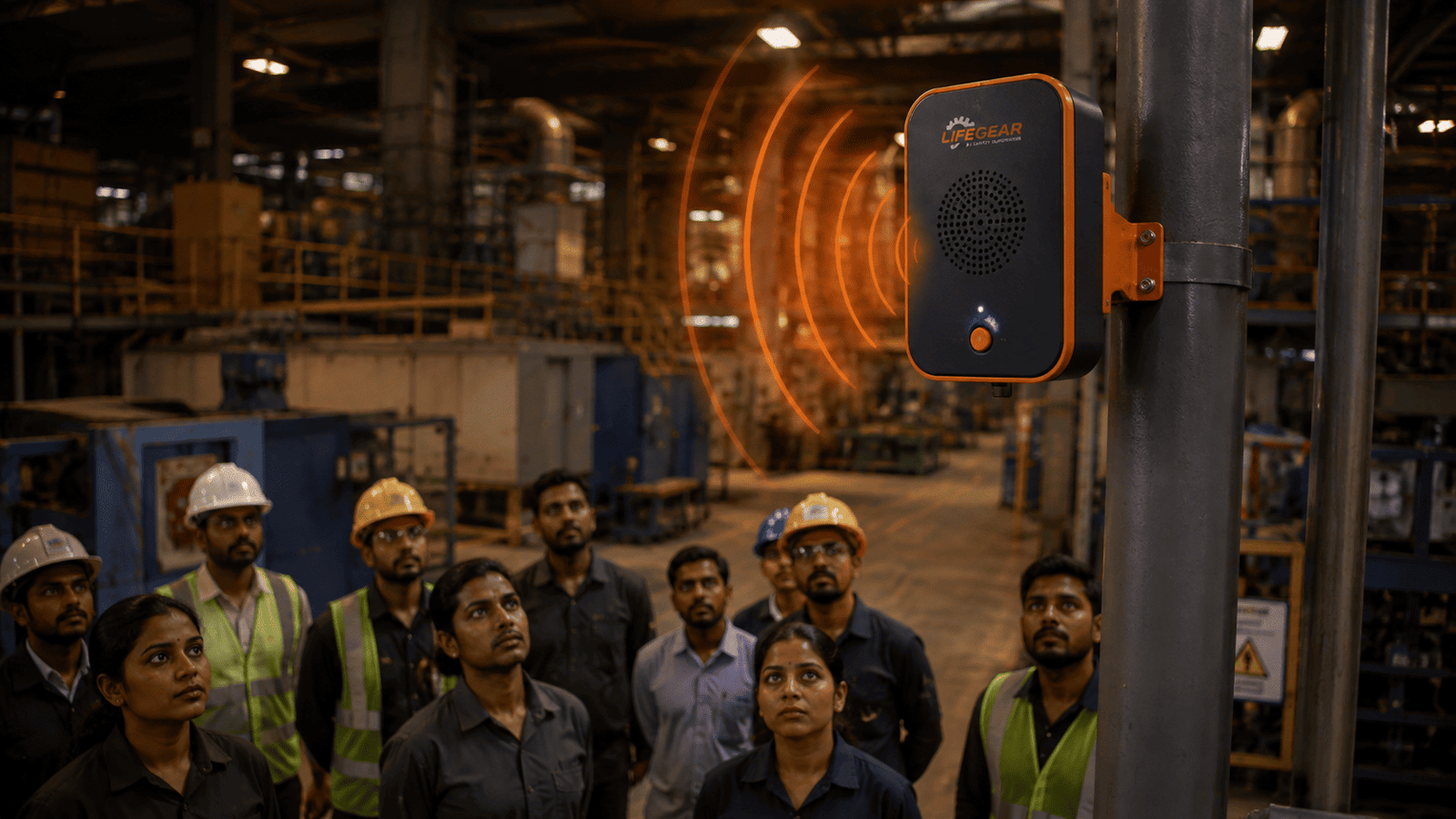
Lifegear's RASU addresses this gap with multilingual voice intervention — delivering spoken safety instructions in the local language at the moment a potential violation or hazard is detected.
Combined with sound and light alerts, the system creates a multi-modal safety communication layer designed to make warnings more immediate, visible, audible, and actionable.
1. The Problem With Safety Alerts Everyone Can't Understand
Industrial safety communication often relies on alarms, sirens, warning lights, signage, or announcements.
These methods are important, but each has limitations.
A siren can indicate that an abnormal situation exists, but it does not provide specific instructions. A written safety sign may be effective for someone who can read the language, but it may not help a worker who is operating machinery or working too far away to see it.
Language adds another layer of complexity.
When workers come from different linguistic backgrounds, a safety instruction delivered only in English or another single language may not communicate the required action as clearly or quickly as intended.
During a real safety event, there is little room for interpretation.
The objective should therefore be simple:
Detect the issue → Speak the warning clearly → Help the worker understand → Enable immediate correction
2. What RASU's Multilingual Voice Intervention Actually Delivers
RASU combines AI-powered detection with on-site voice intervention.
When the system identifies a configured safety violation, it can deliver a spoken instruction in the selected local language directly at the worksite.
This changes the role of the safety system.
Instead of simply recording an incident for someone to review later, the system can communicate with the worker while the event is occurring.
For example, if a configured PPE detection module identifies missing safety equipment, RASU can provide a direct voice intervention to alert the worker and prompt corrective action.
The communication loop becomes:
Camera → AI Detection → Violation Identified → Voice Intervention → Worker Action
This provides an immediate feedback mechanism between the safety monitoring system and the person performing the task.
3. Why Local-Language Intervention Matters
The effectiveness of a warning depends on how quickly the person receiving it can understand the message.
In a multilingual workplace, communicating safety instructions in a worker's familiar language can make the warning more direct and easier to act upon.
This is particularly relevant when the instruction requires an immediate behavioural change.
Instead of relying on workers to interpret a generic alarm or understand a message in a less familiar language, a voice intervention can provide a specific instruction at the point where the issue is detected.
The difference is important:
An alarm tells you something is wrong.
A voice instruction can tell you what needs to be corrected.
For safety-critical environments, that additional clarity can help shorten the time between detection and corrective action.
4. Why Sound and Light Alerts Still Matter
Voice intervention is only one part of effective industrial safety communication.
Factories, foundries, construction sites, warehouses, and other industrial environments can be extremely noisy. Machinery, vehicles, compressors, production equipment, and other operations can make it difficult for workers to hear a spoken warning clearly.
That is why RASU's approach combines multiple alert mechanisms.
Alongside voice intervention, sound and light alerts can provide additional signals when the environment is too noisy or when a worker is not directly facing the system.
The result is a multi-modal warning system:
Voice + Sound + Light
Each channel supports the others.
If a worker cannot clearly hear the voice message, the sound and light alerts provide additional cues. If a generic alarm does not communicate what needs to be corrected, the voice intervention can provide a more specific instruction.
The objective is not simply to make the warning louder.
It is to make the warning harder to miss and easier to understand.
5. From Detection to Immediate Corrective Action
Traditional safety monitoring often follows a delayed process.
A violation occurs. Someone notices it later. The incident is recorded. The worker may receive feedback after the task has already been completed.
Automated intervention changes that sequence.
With RASU, the detection and intervention process can happen while the violation is taking place.
That creates a shorter safety feedback loop:
Violation → Detection → Warning → Correction
The sooner a worker is made aware of a missing PPE item or another configured safety issue, the sooner the situation can potentially be corrected.
This does not replace the role of supervisors or HSE teams. Instead, it provides an additional layer of immediate intervention that can operate continuously across monitored areas.
6. Where Multilingual Voice Safety Alerts Make the Most Sense
Multilingual voice intervention can be particularly useful in workplaces where teams are large, geographically distributed, or linguistically diverse.
Typical applications include:
- Manufacturing plants
- Construction sites
- Warehouses and logistics facilities
- Foundries and heavy industries
- Chemical and pharmaceutical plants
- Infrastructure projects
- Large industrial facilities
- Contractor work areas
- High-noise production environments
- Multi-shift industrial operations
In these environments, a safety monitoring system needs to do more than identify an event.
It needs to communicate effectively with the people who are expected to respond.
Multilingual voice intervention provides a way to make that communication more accessible while sound and light alerts add additional layers of visibility and awareness.
Conclusion
Industrial safety communication is not simply about generating an alarm.
It is about ensuring that the right person receives the right warning, understands it, and can take the appropriate action quickly.
In multilingual workplaces, language can become an overlooked failure point. A warning delivered in an unfamiliar language may not have the same impact as a clear instruction delivered in the worker's local language.
Lifegear's RASU addresses this challenge by combining AI-based detection with multilingual on-site voice intervention, supported by sound and light alerts.
The result is a safety communication system designed around a simple principle:
Clarity, not just volume, is what turns an alert into action.
For industrial environments where seconds matter and teams speak different languages, giving workers a warning they can immediately understand can become an important part of a modern, responsive safety strategy.
Ready to Take Action?
- Give Every Worker a Warning They Understand — Explore RASU's Voice Intervention
- Talk to Our Safety Engineers — Discuss multilingual alerts, detection requirements, and deployment options for your site
- See RASU in Action — Explore AI-powered safety monitoring with voice, sound, and light intervention
References & Further Reading
- Lifegear Safetech — RASU AI Safety Systems: www.lifegear.in
- Lifegear — AI-Powered Industrial Safety Solutions: www.lifegear.in