Industrial Rescue in India: Why Your Plant Needs a Dedicated, Certified Rescue Team
By LifeGear Expert
2026-05-08
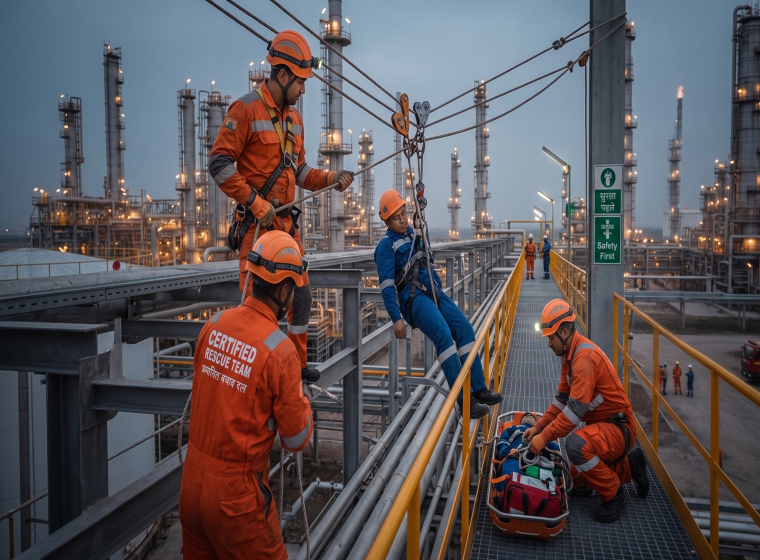
India's heavy industry sector operates at massive scale — thousands of refineries, steel plants, chemical complexes, cement facilities, and power stations, each running round-the-clock operations under high-risk conditions. Yet despite the expansion of HSE frameworks over the past two decades, one critical gap persists across the majority of Indian industrial sites: the absence of a dedicated, professionally trained, and internationally certified rescue team. When a worker falls from height, collapses inside a vessel, or gets trapped in a confined space, the difference between life and death is not just about response time — it is about rescue competency. And competency, in the discipline of industrial rescue, cannot be improvised.
The uncomfortable reality facing most Indian plant heads and HSE managers today is this: their current emergency response capability is built around firefighting and first aid. These are critical disciplines, but they are not rescue. A fire brigade trained to suppress fires and evacuate personnel does not possess the technical skills, specialised equipment, or scenario-specific training to execute a rope rescue from a 40-metre cooling tower, retrieve a victim from an oxygen-deficient vessel, or manage a multi-victim extrication from a structural collapse. When these scenarios occur — and in Indian industry, they occur regularly — the absence of a true rescue capability does not just result in fatalities. It results in rescuers dying trying to save victims.
The Distinction Between Emergency Response and Industrial Rescue
Emergency response, as typically structured in Indian plants, encompasses fire suppression, spill control, first aid, and evacuation. These functions are reactive and general in nature. Industrial rescue, by contrast, is a proactive, technically specialised discipline that requires certified knowledge of rope systems, confined space atmospherics, patient packaging techniques, litter management, and mechanical advantage systems. The equipment alone — tripod retrieval systems, SCBA-equipped entry teams, rope rescue kits with EN-certified components — represents a significant and dedicated investment that is distinct from fire suppression or first aid kits.
Industrial rescue also demands a pre-incident infrastructure that most plants lack entirely. Rescue Site Assessments (RSA) must be conducted for every high-risk work area before operations commence. Rescue Plans (RP) must be documented, rehearsed, and available at the point of work. Equipment must be inspected, serviced, and certified on a scheduled basis. None of this happens organically. It requires a dedicated rescue management system, staffed by individuals whose sole professional function is industrial rescue readiness and response.
The Scale of the Problem in Indian Industry
According to data published by the Ministry of Labour and Employment, India records thousands of industrial fatalities annually, with a significant proportion attributable to falls from height, confined space incidents, and machinery entrapment — all scenarios that fall directly within the scope of industrial rescue. The data, however, understates the true scale of the problem because incident reporting in Indian industry remains inconsistent. Actual near-miss and injury rates are substantially higher than what formal records reflect.
What is particularly concerning is the pattern of secondary fatalities — cases in which bystanders, co-workers, or site safety staff attempting an impromptu rescue die alongside the original victim. This is a globally documented phenomenon in confined space incidents: the majority of confined space fatalities involve would-be rescuers who entered without proper atmospheric monitoring, SCBA, or retrieval systems. The lesson is unambiguous — untrained rescue attempts kill people. The solution is equally unambiguous: professional, certified, dedicated rescue teams stationed at every high-risk site.
What a Professional Industrial Rescue Capability Actually Looks Like
A world-class industrial rescue capability is built on four pillars: certified personnel, specialised equipment, documented procedures, and technology-enabled management. Certified personnel means rescuers trained to internationally recognised standards — the benchmark being the International Technical Rescue Association (ITRA), the global authority in technical rescue competency. ITRA-certified rescuers are trained and assessed to Level 1, 2, and 3 competencies across rope rescue and confined space rescue disciplines, covering everything from atmospheric monitoring and entry protocols to patient packaging and high-angle evacuation.
Specialised equipment includes dedicated rope rescue systems, confined space entry and retrieval kits, atmospheric multi-gas monitors, SCBA sets, and quick response vehicles stocked for immediate deployment. Documented procedures, underpinned by a digital platform like Lifegear's RAP (Rescue Application Platform), ensure that every rescue plan is current, task-specific, and accessible to the team in real time. Together, these four pillars define the standard that Indian industry's most safety-conscious operators — Tata Steel, ONGC, Indian Oil, and others — are now beginning to demand from their rescue service providers.
Lifegear Safetech Pvt. Ltd., established in 2005, pioneered this model in India. With 20 years of operational experience, 50+ active rescue contracts, and 500+ ITRA-certified rescuers deployed across India's refinery, steel, power, cement, and chemical sectors, Lifegear remains the country's largest, most experienced, and most technically capable industrial rescue company. The question for every HSE manager and plant head reading this article is not whether your site needs a dedicated rescue team. It does. The question is whether your current rescue capability meets the standard that your operations — and your people — deserve.
References & Further Reading
- Lifegear Safetech: https://www.lifegear.in
- ITRA: https://www.technicalrescue.org/
Ready to Take Action?
- Contact Lifegear for a Live Demo of RAP (Rescue Application Platform) — www.lifegear.in
- Inquire About Rescue Contracts — Permanent, Shutdown & Turnaround Rescue Coverage Across India
- Learn More About ITRA Certification — www.technicalrescue.org