Two Workers. One Rotating Anchor.
By Lifegear Team
2026-09-06
Introduction: Why Free-Standing Beats Fixed for Shutdown and Turnaround Work
Every shutdown or turnaround planner runs into the same scheduling conflict eventually: two anchor points are needed at a location where no anchor point exists, drilling into structure isn't an option, and there is no time to design and install a permanent one before the work window closes.
The default response is to bring in two separate anchor towers, each bolted or founded independently, each occupying its own footprint, each needing its own installation sequence before either worker can go up. For structural steel erection, tank inspection, or confined space standby work, that is often two problems where the job only has budget and schedule for one solution.
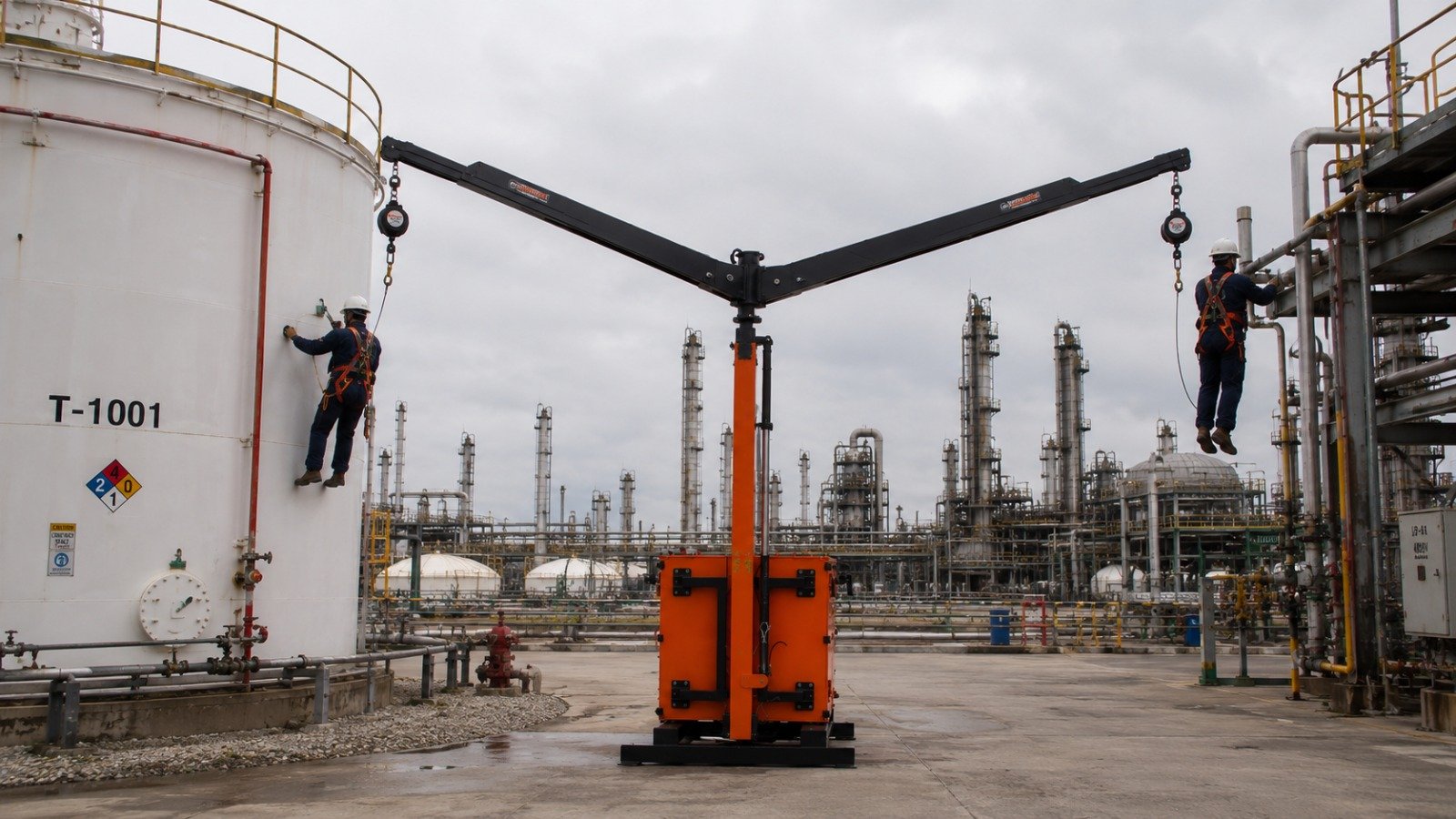
The Counter Weight Girafe — C.W.G. — was built to remove that conflict entirely, by putting two independent anchor points on a single, free-standing base.
1. Why Single-Arm Towers Struggle With Two-Person Work
A single-arm anchor tower is built to protect one worker, at one point, from one base.
When a second worker needs anchoring nearby, the standard response is to deploy a second tower — which, in practice, means a second footprint, and in many cases, a second round of bolting or drilling into the structure.
That works when there's time and structural access to spare. It works less well during a shutdown or turnaround, when the work window is short, the surface may not permit drilling, and every additional anchor installation eats into a schedule that's already compressed.
The result is a structural mismatch: two-person tasks — structural steel erection, tank and vessel work, confined space standby — being served by equipment designed around one anchor point at a time.
2. What the Counter Weight Girafe Actually Delivers
The Counter Weight Girafe solves this by combining two independently rotating arms — 360°/180°, each with a locking mechanism — onto a single base, stabilized entirely by its own counterweight.
There is no bolting and no drilling into structure. The unit deploys on any level surface, held in place by its own mass, which makes it usable in exactly the settings where a bolt-down system can't go — rooftops without accessible structure, tank tops, or temporary work platforms.
Each arm carries a tested capacity of 140 kg, for a combined 280 kg safe working load across two users, with track-trolley arm moments that let each arm's reach be fine-tuned to the precise point of work. The mast extends to 6.5 m in a 3-stage configuration with 3 m double-extended arm offset, and the unit is available in 6H2R, 7H3R, and 9H3R configurations to match different working heights on the same site. Lifting is hydraulic and AC-driven, and the base is engineered for transport via its own stabilizer.
Like Lifegear's other Girafe-series anchors, the C.W.G. is certified for both fall-arrest and rescue use under EN 795 Type C & D and CEN/TS 16415:2013.
3. Where It Is Already Working
The Counter Weight Girafe is deployed across shutdown and turnaround work, structural steel erection, and confined space standby — the specific category of task where two workers need to anchor simultaneously and neither drilling nor a multi-week installation is realistic.
Sectors already using the C.W.G. include metro & rail, construction, oil & gas mining, chemicals & pharma, railways, metals & cement, telecom & datacenters, and fire rescue & disaster management.
4. The Case for One Base Instead of Two Towers
For a turnaround planner, the calculation is straightforward: one free-standing base that serves two workers replaces two separate tower installations, without the drilling, the extra footprint, or the extra time on a schedule that's already tight.
Because the unit requires no foundation, it can be repositioned as the two-person task moves — from a shutdown zone to the next vessel, from one structural bay to the next — without re-engineering an anchor point each time.
For sites running frequent shutdowns, turnarounds, or structural campaigns, the Counter Weight Girafe converts a recurring two-anchor problem into a single piece of owned equipment that moves with the work.
Conclusion
The Counter Weight Girafe changes the approach to short-term, high-risk work environments by eliminating the requirement for complex foundations while securing multiple operators simultaneously. Investing in versatile, mobile safety infrastructure directly optimizes both jobsite productivity and compliance.
Ready to Take Action?
- Contact Lifegear for a Site Assessment of the Counter Weight Girafe — www.lifegear.in
- Talk to Our Safety Engineers — Site assessment, model selection, and dispatch, in one call
- Learn More About ITRA Certification — www.technicalrescue.org
References & Further Reading
- Lifegear Safetech — Counter Weight Girafe: www.lifegear.in
- ITRA: www.technicalrescue.org